Showing posts with label Dept for Work and Pensions. Show all posts

Monday, 14 March 2011

Scotland - How Cuts Affect Real People


Carers Votes Count in this Election
Everywhere you look there are stories in the press about cuts to funding and services – but what does that mean to the people who use those services?

Cuts to local budgets are having a profound impact on the lives of unpaid carers, particularly parents of children with disabilities.  This is largely hidden from the electorate.  And many of the people affected are too tired – or too scared – to hold their heads up and fight for the support they need. 

Support enables families to stay together. Support prevents crises from developing and the need for statutory services to get involved in depth.  Bring into the mix the impact of welfare reform and the drive to reduce numbers claiming disability benefits – there is a tipping point for families and children affected and we are getting closer to it.

Carers’ charities and online campaigners are working together to ensure the voices of these unpaid carers and their families are being heard and responded to during the election campaign.

The Princess Royal Trust for Carers (The Trust) and ACT NOW (Autism Campaigners Together) want to raise the profile of families affected by autistic spectrum disorders. There are an estimated 50,000 people with autism in Scotland and their care is largely provided by unpaid carers, usually parents and siblings.  

The Princess Royal Trust for Carers work with parent carers across Scotland through the network of local Carers’ Centres. ACT NOW are a core group of people passionate about the future and wellbeing of children and adults with an Autistic Spectrum Disorder in the UK.  

With a live campaign on the internet and Facebook, ACT NOW are fighting the cuts to benefits, services and provision – particularly those being experienced by families affected by Autistic Spectrum Disorders.
 
Carers across Scotland save the Government millions – an estimated 1 in 8 people are caring for someone in Scotland. The Princess Royal Trust for Carers, ACT NOW and other campaigning groups want to highlight the horrific circumstances faced by parent carers across Scotland.  

Not recognising and supporting these families could lead to:
  • Parents having to give up work to care for their children or just to enable them to take part in activities and events at school as numbers of personal assistants in school are cut.
  • Children not being supported in class and unable to take part and learn – leading to under achievement, behavioural issues, children being excluded from school and in turn moving into a life of unemployment and poverty.
  • Parents having lifelong caring responsibilities when young people do not achieve independence and the worry about what happens when they are no longer there to look after their adult children.
ACT NOW and The Princess Royal Trust for Carers are calling for the voice of these carers to be heard during the Scottish Election Campaign.  They are calling for existing MSPs and new candidates to lay out what they will do to ensure parents, like those outlined in the case studies below, are recognised and supported better and that children with autism have the same opportunities and life chances as their peers.

ACT NOW in Scotland have been recording the personal testimonies of people with autism and their carers who are being affected by cuts in service provision and by the Work Capability Assessment.  Part of the campaign focuses on challenging the lack of awareness that assessors from ATOS (contracted by DWP) have of autism. ACT NOW is campaigning for the rights of people with autism to have an advocate present from the first point of contact by the DWP.  They are also campaigning for greater input by carers and guardians during the assessment.

More widely, the proposed changes to DLA and the introduction of Personal Independence Payment (PIP) are sources of great concern.  Welfare reform will impact on these families in a hugely negative and life changing way.

ACT NOW are regularly hearing from parent carers who lie awake at night terrified because they don't know what will happen to their adult children, especially if their benefits and support provision is taken away, largely due to ignorance about autism. The health of carers when living with these pressures and strains daily is precarious, especially if they feel they and their children are being discriminated against and don't have a voice. Demand at Carers’ Centres across the country is increasing substantially as local cuts bite and the welfare reform agenda unfolds.  There are lots of warm words about the contribution that parent carers and unpaid carers make – this must be translated into firm commitments and actions.
Case studies

Parent in Edinburgh

Living with a very aggressive son (6). Child and Adolescent Mental Health Services have said they "don't have the resources to support them fully right now". This family is at crisis point and without help from a local charity, they probably couldn't have stayed together.

Parent in South Lanarkshire

Son's (23) Disability Living Allowance Care Component has been reduced from high to low upon review because review deems he doesn't need help to communicate, eat/drink and is not at risk of neglecting himself (amongst other things). None of that is in fact true and no professional who has had contact with this young man has been asked to verify any of his difficulties. This is despite his diagnosis and years of necessary support for these very issues. The parent is appealing but is really struggling financially to support her son as this reduction has meant the removal of her Carer’s Allowance.

Parent in Glasgow

Son (12) hasn't been in school (a specialist unit for children with communication disorders) since early February because there aren’t enough members of staff to ensure his safety. The education department has confirmed that new staff have been found, but can’t confirm when the child will start back in education again because those employees need to be trained. She has had to take legal advice because of poor communication and this has affected her ability to work.

Parent in Aberdeen

A single mum with three kids (one of whom has Additional Support Needs  and is in a special school). Her eldest boy who has Autistic Spectrum Disorder,  has been out of primary school (P6) for months because the school "can't cope" with him because of his challenging behaviour. They have had the police round nearly every day as neighbours complain and she has been advised to lock herself and her two other children away if her son "loses" it. She is at her wits end and has even asked Social Work to take her son into care. They refused as she has the support of her mum.

Wednesday, 2 March 2011

DWP Factsheet: Support offered by Jobcentre Plus for customers with additional support and communication needs

Letter to Chris Grayling, Minister for Employment
Dear Mr Grayling

We are most concerned about the information that is being displayed on the DWP site for customers with additional support and communication needs http://www.dwp.gov.uk/docs/ib-reassessment-additional-support.pdf

The Factsheet states that ‘Customers will receive a letter from Jobcentre Plus telling them that their benefit is being reassessed. Jobcentre Plus will then call the customer to discuss how this change will affect them and to answer any questions.’  Adults with autism will need to be offered support and the opportunity to access an advocate/communicator before the phone call takes place.

The Factsheet continues ‘During this telephone call the customer will be asked if they have any additional communications needs.’ Without support an adult with autism may be unable to identify their own communication needs and being unable to identify and label how their disability impacts on their life is one of the problems that adults with autism face. Therefore it is absolutely essential that adults with autism require an advocate/communicator to be present with them when the phone call is made.

We acknowledge the fact that Jobcentre Plus will support a customer’s right to have representation but an adult with autism needs to be aware of this at the first point of contact. Arrangements then need to be put into place to ensure that support is offered in the form of either an independent trained advocate or someone who the person with autism is comfortable with and who they are happy to help them to communicate effectively.

The factsheet continues by giving specific information for customers for whom English is not their first language, customers who are visually impaired and customers with hearing and speech impairments. The factsheet excludes anyone who has a diagnosis of autism which is a recognised communication impairment.

The factsheet is totally inadequate and should be withdrawn until a proper system can be put in place before any contact is made by Jobcentre Plus.

Monday, 28 February 2011

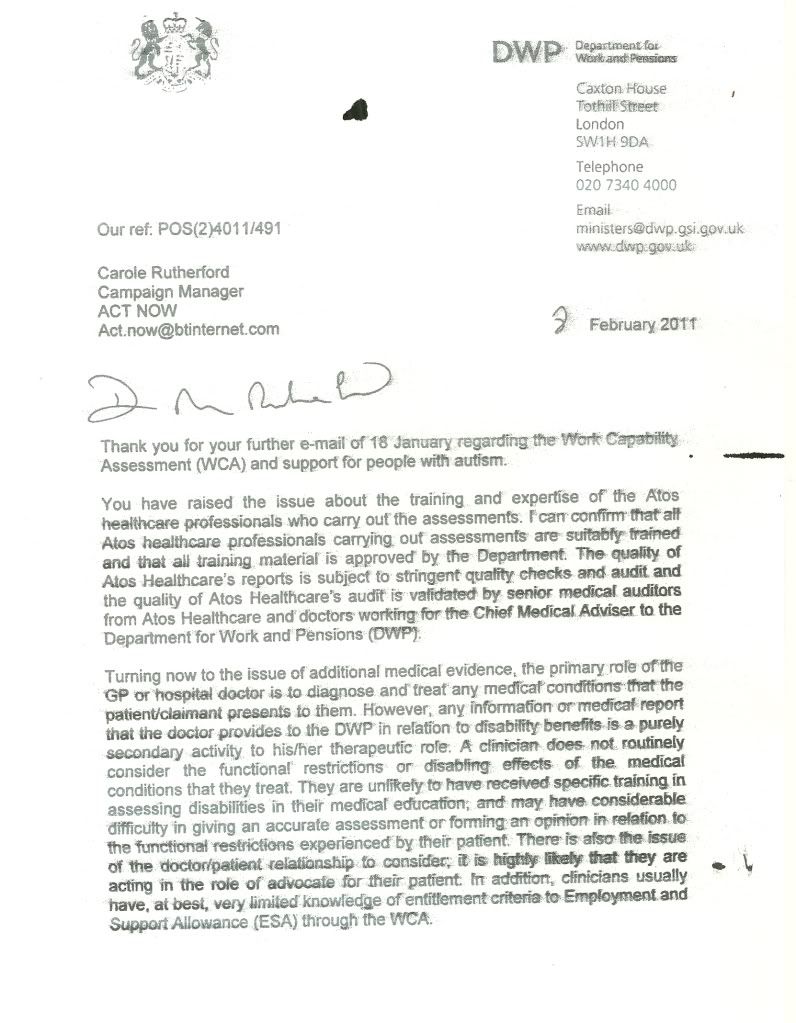
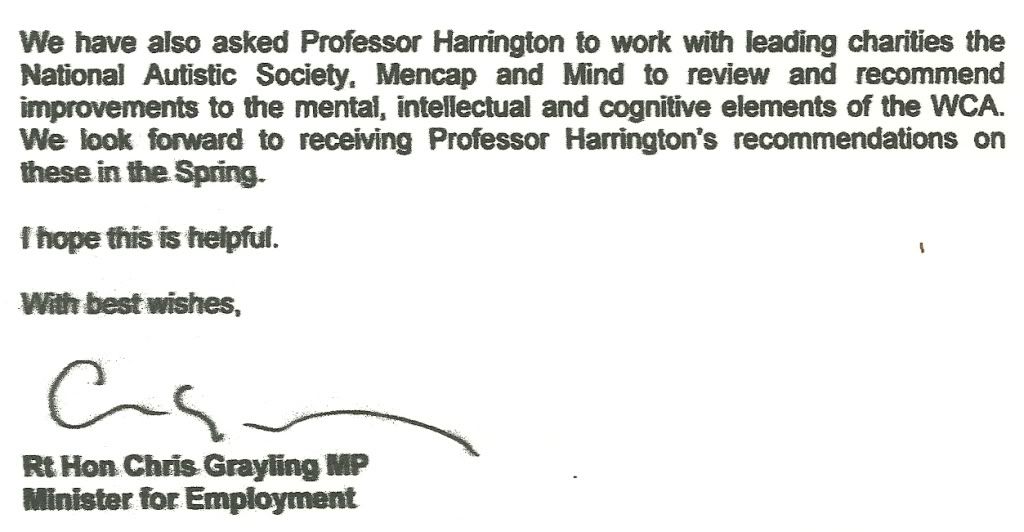
Response from Chris Grayling DWP - Work Capability Assessments


ACT NOW's reply to Mr. Grayling sent today

We thank you for your letter dated 8th February. We have also received a letter from Professor Harrington who tells us that he was copied into your response to our letter dated 18th January.  We are copying Professor Harrington into this letter as well as Iain Duncan Smith and Anne Begg, Chair of the Department of Work and Pensions Select Committee.

ACT NOW seeks reassurance, as do our supporters, that in line with Section 20 part 5 of the Equalities Act an auxiliary aid will be provided for every adult with autism who is asked to take part in a Works Capability Assessment.  

Given that autism affects every aspect of communication, receptive and expressive as well as social communication, we believe that an auxiliary aid (which for an adult with autism would be an advocate/communicator) is a necessary reasonable adjustment. This would help to ensure that adults with autism are not put at a substantial disadvantage in relation to a relevant matter in comparison with persons who are not disabled. 

It is essential to ensure that all of the communication needs of adults with autism are met. We would also state that we believe that it is important that any auxiliary aid that is offered to an adult with autism will be independent and not part of the DWP.
Yours sincerely
-------------------------------

Wednesday, 23 February 2011

Letter to the DWP Select Committee

DWP Select Committee Members are: Dame Anne Begg (Chair) Labour, Harriett Baldwin Conservative, Andrew Bingham Conservative, Karen Bradley Conservative, Alex Cunningham Labour, Kate Green Labour, Oliver Heald Conservative, Glenda Jackson Labour, Brandon Lewis Conservative, Stephen Lloyd, Liberal Democrat, Teresa Pearce Labour
-----------------------------------------------------------
Dear Members of the DWP Select Committee

I am writing to you on behalf of ACT NOW (Autism Campaigners Together) a group of people passionate about the future and wellbeing of children and adults with an Autistic Spectrum Condition in the UK.  ACT NOW is run solely by volunteers the vast majority of whom are living with autism 24/7.

The ACT NOW Campaign currently has over 8000 supporters. We have 13 Regional Groups including a group in Scotland, Wales and Northern Ireland, 25 Regional Coordinators and our support continues to grow on a daily basis.  ACT NOW is also supported by autism professionals, groups and organisations that support families living with autism and adults with autism here in the UK. 

The Welfare Reforms and the Works Capability Assessments that are to be rolled out across the UK on February 28th are a source of huge concern for ACT NOW and our supporters. We believe that these assessments will place adults with autism at a huge disadvantage.  

ACT NOW believes that the WCA process is fundamentally flawed and unless the present method of assessment is completely overhauled, adults with autism and adults with other complex disabilities will continue to suffer and be punished for having a disability which does not fit into the current assessment framework.
These sentiments were echoed in an article published in the Guardian Newspaper Tuesday 22nd February where Professor Paul Gregg (economist and welfare reform expert) stated that a ‘rushed roll out of the work capability assessment will cause more anguish’ and that ‘the test is badly malfunctioning. The current assessment is a complete mess’.
We believe that unless the offer of an independent advocate/communicator is made to every adult with autism at the first point of contact, that the DWP are probably breeching the Equalities Act by failing to make reasonable adjustments for someone whose disability impairs both their receptive and expressive language, thus affecting every communication that they make.  

The very core of our campaign relates to how people with Autistic Spectrum Conditions will perform in assessments. Adults with Autistic Spectrum Conditions infrequently represent how their disability impacts on them accurately. These assessments are wrapped around the medical and social model of disability and are in effect discriminating against adults with autism who do not have a medical disability and who continue to fall between the cracks of the medical and social model of disability. 

After writing to Chris Grayling regarding our concerns we received a reply informing us that Atos assessors are specifically trained in the assessment of disability. He states that ‘the medical disability analyst will be able to provide an accurate and consistent assessment of functional restrictions.’ 

Autism is not a medical disability. It is a complex condition whose roots are firmly planted in social and communication impairments.  Autism is diagnosed using a triad of impairments which are communication, socialisation and imagination. It can take months, sometimes even years to obtain a diagnosis of autism. It is difficult to understand how after one assessment it will be possible for anyone who does not understand the complexities of autism to accurately assess the difficulties that that person may have in their everyday lives. 

Mr. Grayling also stated in his letter to ACT NOW that any additional medical evidence that is presented to the Atos assessor by an adult with autism will be treated as purely secondary information. He states that clinicians do not routinely consider the impact that a disability a person has will impact on their ability to function. This greatly worries ACT NOW and our supporters. 

It is our understanding that the Atos assessment is based on an assessment that originated in America and which was used by the Unum Unumprovident, Provident Life, and Paul Revere companies. We also understand that Unum Unumprovident, Provident Life, and Paul Revere companies have been named in almost 5,000 civil actions concerning insurance from 2000 to the present.

We are aware that problems that came to light with the assessment process were disabilities wrapped around mental or nervous disorders which could not be proven by hard medical evidence such as an x-ray. Autism is not a medical condition.

ACT NOW believes that it is both cruel and immoral to subject someone with autism to an assessment which does not in any way reflect the vastness of the autistic spectrum.

It is unquestionably the case that adults with autism often find it difficult to fill in the forms that are usually required to be completed prior to assessments. This is because it is not only their verbal communications that are impaired, but also all other forms of communication including written communication.

Given that it is highly likely that adults with autism will be placed at a substantial disadvantage by these assessments, it is vital that everything is done to support a person during the process. It is essential that the relevant public bodies are proactive in offering and supplying independent and meaningful support at the earliest opportunity.

ACT NOW has been told by adults with autism and their parents and carers that although they are informed that someone can attend an assessment with them, the person attending with them is not always allowed to speak on behalf of the adult. Some parents are reporting that they are not being allowed into the assessment room with their adult child. We have heard via one of our supporters whose daughter is almost non verbal, that while she was allowed into the room with her daughter during the assessment she was not allowed to speak. We find this very disturbing. Adults with autism require someone who can both interpret and communicate on behalf of the person with autism. Interpreters would be provided for anyone who could not speak English. We believe that adults with autism require the same type of adjustment to ensure that they can communicate effectively.

As Atos are part of a consortium which intends to bid for Work Programme provision contracts ACT NOW believes that there is a fundamental and irreconcilable conflict of interest here – part of which is the possibility of bias entering the DWP Medical Assessment, where Atos know that finding somebody fit for work might bring more business their way, whereas finding them unfit for work would not do so.  We have also heard that Atos have targets to meet for getting people off ESA benefit and onto Job Seekers Allowance.

Autism is not an illness. Adults with an IQ of over 70 often do not meet the criteria to be even seen by anyone who has an expertise in autism. It is only now that it has been stated in the Guidance which accompanies the Adult Autism Strategy ‘Fulfilling and Rewarding Lives’, issued in December 2010, that IQ must not be used as a reason to deny an adult with autism an assessment for services or provision. Thus there are huge numbers of adults who have been denied access to assessments for services and provisions, many of whom are hidden within our communities unsupported.   

There is currently no adult autism strategy in Scotland; provision is not statutory once someone with an IQ of higher than 70 reaches adulthood. Adults with an IQ of lower than 70 still have little support and have to fight for what they need. Who will support these adults and provide any additional evidence if required?  Only 7,500 people with autism are known to local authorities in Scotland although the National Autistic Society concluded that, including parents and carers, there are some 200,000 people affected by autism in Scotland. 

We believe that it is unlawful on human rights grounds to force disabled individuals with Autism and Aspergers Syndrome to engage in a process where they are substantially disadvantaged. We believe that being unable to communicate effectively could impact on the health and wellbeing of an adult with autism and the Equalities and Human Rights Commission agrees with us.

ACT NOW would like to request an opportunity to meet with the DWP Select Committee so that we can discuss with you, in person, the concerns that not only the ACT NOW core group has, but the concerns of many thousands who are living with autism everyday share. 

Carole Rutherford
Campaign Manager
For & On Behalf of ACT NOW (Autism Campaigners Together)

Monday, 7 February 2011

ACT NOW Proposals to our Patron Jon Cruddas MP

Following our meeting at Portcullis House we have given a great deal of thought about not only the Work Capability Assessments and how they could be made autism friendly, but also how a default position for adults with autism, as well as any adult who has a lifelong complex disability, could be made possible.

The core group has, we believe, produced some proposals which would stop the Work Capability Assessment from placing adults with autism at a serious disadvantage. We have also produced some proposals which would be used to create a default setting for adults with autism who wanted to seek and gain employment without any fear of conditionality if their attempts to do so failed.
 
During the last seven days we have discussed our proposals with our Regional Co-ordinators and the 792 ACT NOW supporters who are active members on our Regional Groups. The response has been favourable and we have received no negative comments.
 
We believe that in its present format the WCA will place people with autism and other complex disabilities at a disadvantage. It is not always apparent that someone with autism has a disability because autism can be a hidden disability and the needs of the person with the condition can fluctuate on a daily basis depending on their environment and levels of anxiety.  It can be very difficult for someone who has not been specifically and specially trained in autistic spectrum conditions to effectively determine the impact that the disability has on the person with the condition in a relatively short assessment process.
 
We believe that a radical overhaul of the assessment process is urgently required. Tinkering with the descriptors to decide who should be eligible for Employment Support Allowance and what level of support they should get will not be enough to prevent adults with autism from being declared fit for work, when in fact they are anything but fit for work.
 
While the descriptors may better reflect the needs of people with autism and other disabilities, they will not provide the assessor with the overview and insight into the condition that the assessor should clearly have if they are to reach an informed decision that will impact on the life of the person whom they are assessing.
  
We believe that the Department for Work and Pensions needs to urgently expand its LIMA system (Atos Origin’s Logic Integrated Medical Assessment information technology software) to encompass lifelong conditions like Autism, Down Syndrome, Cerebral Palsy etc and produce a set of guidelines similar to the NICE Guidelines.  It is difficult to imagine how an assessment can be successful without the assessor being able to access information that will allow them to understand the condition that the person they are assessing.
   
Training on Autistic Spectrum Conditions should be mandatory for all ATOS assessors.  
 
At the moment there are only 15% of adults with autism in full time employment. This is opposed to 48% of adults with other disabilities being in full time employment.  While some adults with autism do want to work it must be recognised that for some adults with autism living an independent life without employment will be a positive outcome for that adult. Being able to live independently is something that should be a higher priority than employment for some adults with autism.
  
For this reason we believe that it is essential that there is a default position available to adults with autism (and others with similar disabilities) who try to seek and maintain employment and for whatever reason fail. Autism must be categorized as a high risk group, recognising that adults with this disability often find it difficult to seek and maintain employment.
 
Proposals for long term improvements to the system.
 
There is no reason why all of the assessments that an adult with autism may require (this could include community care and social care assessments) could not be carried out all at the same time under the supervision of a specialist body who is, importantly, not part of the DWP. These assessments could be carried out by a local Community Care Team; a similar idea has been suggested in relation to children with Special Educational Needs and how these are assessed. The outcome of the adult assessment would lead to a Disability Development Plan which would very importantly state the following
 
1. The person's disability and whether this was a statutory disability
 
2. How the disability impacts on them as an adult in relation to key areas such as well being, independence*, employability etc
 
3. What support they are entitled to both in terms of benefits and whilst at work in the form of reasonable adjustments and ongoing support.
 
4. Explore areas of employment that the adult with autism may be capable of doing, as well as what kind of reasonable adjustments and support would have to be put into place for that adult.
 
5. All of the medical needs of the adult would be listed. This is important as adults with autism often have co-morbidities and other disabilities in addition to their autism which impact on their autism and ability to function.
 
The Disability Development Plan could be reviewed for everyone after every 3 years.
 
There should be a mechanism to record significant changes with regards to disabilities and how they affect the relevant person. This may seem like a costly process but firstly it would be voluntary ( ie. if the disabled person did not want to apply). However if the disabled person wanted benefits or community care facilities we suggest it would have to be compulsory. It would be very beneficial to employers as it would give them more meaningful information about the disabled person.
 
Clearly the plan would have to be person centered and a great advantage over the existing system. We have no reason to believe that this way of assessing would not save money in the long run whilst ensuring that the disabled person was given the relevant support when needed.
 
* National Autistic Society Campaign ‘I Exist’ 2008 61% of adults with autism rely on their families for financial support with over 40% of adults with autism still living at home.
 
Do not hesitate to contact us if you have any queries.

Tuesday, 18 January 2011

Letter to Chris Grayling MP Minister for Employment

Dear Mr. Grayling

Thank you for your letter dated 20th January 2011, however we feel that you have failed to answer some of the questions we asked in our letter dated 13th December 2010.

We are pleased to be informed that the ATOS assessors are aware of the potentially disabling effects of impaired social interaction, language and communication skills in people with autism and that they are determined to assess customers with autism fairly and accurately.  Unfortunately your letter failed to give us an explicit assurance that all of the ATOS assessors are suitably trained, that the training is accredited and being overseen by an independent body.  Can you please assure us that this is indeed the case with all current ATOS assessors and will be true of assessors being appointed?

Every person with a diagnosis of autism has a significant communication and socialisation impairment; even those with Aspergers Syndrome who often are deemed to be more able than those with a diagnosis of autism. ACT NOW is being told about the inadequacies of the ATOS assessors, that they lack a basic understanding and awareness of the condition of their customers.  We are alarmed that assessors are even overturning professional medical evidence. We do have case studies in support of this.

In your letter you state that the Works Capability Assessment was developed in consultation with disability groups including the National Autistic Society. The NAS states however, as part of an introduction written for Professor Harrington (heading the Independent Review of the Works Capability Assessments for the DWP) that they, along with other organisations, have: 

‘experienced some difficulties engaging with the Department for Work and Pensions around welfare reform and at times, have felt that our attempts to influence the process have been limited, with little evidence that our concerns and objections have been considered, and yet our involvement in consultation has been used by government as a source of legitimacy for reforms.’

Professor Harrington has asked the National Autistic Society, Mencap and Mind to propose amendments for the WCA descriptors.

We believe that there are a great many factors to be taken into account when a WCA is undertaken on an adult with autism. The capability to work or the inability to be capable to seek or maintain employment, for some adults has been heavily influenced by the failure of the state to provide a suitable education and suitable health care, therapies and interventions for these adults, often throughout their childhood. There is substantial recorded evidence of systemic failure to provide suitable education, therapies and interventions for children with autism (see *1,2,3,4)

Even with Works Choice it is difficult to imagine that some adults with autism are going to be able to not only seek employment but also take up their place in a work environment, whilst lacking the basic skills denied them throughout their childhood, and without which it will be very difficult or in some cases impossible for them to successfully maintain their employment.

ACT Now has heard from adults with autism who want to work and some of whom have worked, that if they are finding it hard to cope with their employment and have asked their employers to contact Prospects (employment consultants offering advice, support and training to managers and their teams) their employers fail to do so, leaving those adults to fail again.

Both children and adults with autism find it extremely difficult to start over after they have experienced a failure in their lives, often requiring enormous amounts of support to be able to do so. The Autism Strategy, which many parents and adults believe will not make the difference that we had so hoped for, has not yet had the chance to bed in and so it is too early to determine if there will be any additional and maintained support for our adults in both seeking and maintaining employment.

Whilst ACT NOW understands that being able to record a WCA would undoubtedly be a step in the right direction, it does nothing to reduce the levels of stress or anxiety that adults with autism will experience prior to their assessment unless they are able to access, in their own right, appropriate support. ACT NOW has been speaking to adults with autism and organisations supporting adults with autism and we are being told that people are worried, some even terrified, at the prospect of WCA assessments.

There is a huge amount of stress and anxiety being experienced by adults who so far have not even been asked to attend a WCA, such is the fear factor that is surrounding these assessments.  Even the thought of an assessment is affecting their mental health. This of course is not being helped by revelations coming to light that there appears to be clusters of adults in some areas all being declared fit to work when from evidence on the ground, demonstrably they are not.

ACT NOW is making a national call for Advocate/Communicators for all adults with autism. We believe it is essential that all adults with autism are offered support, at the first point of contact, when it is known a WCA is going to take place. It is unquestionably the case that adults with autism often find it difficult to fill in the forms that usually are required to be completed prior to assessments. This is because it is not only their verbal communications that are impaired, but also all other forms of communication including written communication.

Given that it is highly likely that adults with autism will be placed at a substantial disadvantage by these assessments, it is vital that everything is done to support a person during the process. It is essential that the relevant public bodies are proactive in offering and supplying independent and meaningful support at the earliest opportunity.

There are many adults in our community who no longer have parents to support them and who have not been seen by the medical profession for many years and so they will have no medical evidence that they can submit to the WCA assessor. Who will these adults be able to access for additional evidence about their condition on their behalf? Autism is not an illness. Adults with an IQ of over 70 often do not meet the criteria to be even seen by anyone who has an expertise in autism. It is only now that it has been stated in the Guidance, issued in December 2010, that IQ must not be used as a reason to deny an adult with autism an assessment for services or provision. Thus there are huge numbers of adults who have been denied access to assessments and many adults are hidden within our communities unsupported.

ACT NOW must point out that it is unlawful to force disabled individuals with Autism and Aspergers Syndrome to engage in a process where they are substantially disadvantaged.   Furthermore, public bodies need to be mindful of the fact that failure to provide appropriate support will further undermine self confidence and life chances of a group of people who are without question one of the most disadvantaged in our society.

ACT NOW has the support of over 8,000 members of the autism community. The overwhelming majority of our supporters either have autism or are the parents of those with autism, in other words people on the front-line all day, every day.  We speak on behalf of a considerable number of people and believe it would be most helpful if representatives from ACT NOW were able to meet with you to discuss what we believe to be justifiable and serious concerns about the Works Capability Assessments and the process leading up to and after these assessments.

Yours sincerely
*1 Schools fail autistic children - http://news.bbc.co.uk/1/hi/education/5350506.stm

Monday, 17 January 2011

Response from Chris Grayling MP Minister for Employment

We have received a reply to our email letter from Chris Grayling, Department for Work and Pensions and are disappointed to learn that he will not be able to meet with us.  However, he has indicated that he will respond to us on our concerns and we will be pushing for a reply!

Tuesday, 4 January 2011

ACT NOW Letter via email to Jon Cruddas MP (Labour Party)

Dear Mr. Cruddas

I am writing to you after reading an article published in the Guardian ‘Up to 500,000 wrongly denied incapacity benefit figures show’ on Monday 3rd January 2011.

I am the Campaign Manager of the ACT (Autism Campaigners Together) NOW Campaign. I am also the Mother of two autistic sons. ACT NOW currently has 7,500 supporters. Our campaign only began in July 2010.  All of our supporters are living with autism.

The ACT NOW campaign was born out of a sense of total despair within the autism community that the proposed cuts to budgets coupled with the benefit assessments that adults with autism are required to have would have a catastrophic affect on our lives.

Within 4 months we had 6,000 supporters and we had compiled an ‘ACT NOW Impact Assessment Report’ (report attached) which was based on 2,943 pieces of evidence received from parents, carers and adults with autism, and which we published in October.  Our supporters overwhelmingly are people affected by Autistic Spectrum Condition (ASC) or parents and carers of children and adults with ASC.  We are on the frontline 24/7 and collectively have a pre-eminent knowledge and understanding of the practical issues those with ASC or their parents and carers face.

Our concerns regarding the reassessment of benefits being received by adults with autism are also growing daily. We are aware that in one area alone 11 adults with autism have been declared fit for work after being assessed by ATOS professionals. We are hearing of other areas where this is happening almost on a daily basis now.

Autism is a triad of impairment, two of which are communication and socialisation. Before a diagnosis of autism is made the person with the condition must be assessed as having a significant impairment in both communication and socialisation and yet there are no adjustments being made by providing advocate/communicators for the adults within our community. ACT NOW totally supports your call for a pause in this particular aspect of the government's crackdown. Communicating with the Department for Works and Pensions is proving to be difficult.

We understand that the Labour Party wishes to re-connect with people. ACT NOW is a frontline group who is connected to its supporters at grass roots level. While we do not provide any direct services we are the genuine voice of those in our communities disadvantaged through autism. We would like to ask you to consider becoming a supporter for our campaign and if you would be willing to meet with us to perhaps look at the evidence that we are collecting wrapped around our campaign. We are looking for someone to give us a voice.

Our current concerns include:

·         That there continues to be a frightening lack of understanding and expertise about autism spectrum conditions and how they impact on the lives of those with the condition and their families.
·         The unsatisfactory Autism Strategy and the inadequate, woolly Statutory Guidance for local authorities and NHS organisations published by the Department of Health in December 2010
·         The cuts being implemented by local authorities across a range of services which are impacting severely on the health and well-being of people affected by ASC and their families.
·         The process surrounding Work Capability Assessment (WCA) and Employment & Support Allowance (ESA). We have clear evidence that those making the assessments have little understanding of autism and the impact autism has on the ability to hold down a job. We are aware in one area alone 11 adults with Aspergers Syndrome have all been declared fit for work after being assessed by an ATOS professional.
·         Plans to withdraw Legal Aid for individuals wishing to appeal to Tribunals or the Upper Tribunal.
·          Lack of representation by a large group of people with a complex disability. We are aware that there are no autism specific groups or charities working collaboratively with the Department for Work and Pensions who are currently consulting regarding the abolishment of Disability Living Allowance which will be replaced by Personal Independent Payment. 

Many of our supporters are literally sick with worry and foreboding at what the future holds for them. 

We hope that you will share our concerns and consider working with us to ensure a better life for those our organisation has been formed to support.

Yours sincerely
 
Carole Rutherford
Campaign Manager

Sunday, 2 January 2011

ACT NOW Supporters Club!

ACT NOW needs more supporters
We need to become a force to be reckoned with and to do that we need to be able to speak ‘with one voice’ for as many people as possible. Although we did very well with our petition and are able to say that we have just over 6000 named supporters, we need to times that number by around ten if we can. 
We need named supporters. Named supporters can be parents, carers, grandparents, siblings (over 18’s only) aunts, uncles in fact anyone who is a family or extended family member, who can say that they are supporting ACT NOW because they have a relative with autism. 
We are fully aware that not everyone in our families are able, or even want to, access the internet. So we would like our named supporter to ask their family members if they are willing to support the ACT NOW Campaign. If your family members are happy to support us then we need you to add their names to our supporter’s club list. It is important that those who have their names added understand that by adding their name to our supporter’s club this means they are actively supporting the ACT NOW campaign.  
All we require from our supporters is their full name, town of residence, postcode and email address (if any) - there is no need to give a full address. Click here to join us online! or email us act.now@btinternet.com
Please Note:  ACT NOW Autism Campaigners Together are registered with the Data Protection Act Registration No.  1124511 and will not disclose any information to any third party.

Thursday, 30 December 2010

Are you an Autism group or organisation?

Let's support each other
ACT NOW are pleased to announce two new additions to our growing list of named Supporters.  

We welcome Indigo Kids - a support group for parents/carers of children on the autism spectrum in Nottinghamshire and the Learning Disability Coalition where organisations work together to ensure there is enough public funding for people with a learning disability to have the same choices as everyone else.

If you are a parent/carer support group or autism organisation in the UK and would like to support our work and share reciprocal website links with us, please get in touch.  Also, if you belong to any autism groups in your area please let them know about our campaign - we need to continue to reach as many people as possible! We look forward to hearing from you.

Best wishes
Admin

Benefit Assessment Advocates/Communicators for EVERY adult with ASC

We MUST start fighting for advocates/communicators for every adult with an ASC who has to have a benefit assessment. We MUST do this because we MUST remember that this Government has not ruled out children having to have these assements too. We have yet to receive a response to our letter of 13th December from Chris Grayling MP seeking clarification on what is included in the autism training modules that have been developed by ATOS and the DWP.

In the News. Benefits advice to be slashed – with little resistance - 23 November 2010

The coalition’s plans to end legal aid for many areas of law, including welfare benefits, have so far met with a muted response. This is in spite of the havoc it is likely to cause to both claimants and the advice sector, where many agencies may shrink drastically or close down altogether.

The Proposal for the Reform of Legal aid in England and Wales green paper was published on 15 November. In it, the coalition sets out its plans to slash legal aid for the poorest in society. Amongst the plans is the removal of legal aid for:

•debt,
•education,
•employment,
•housing,
•immigration,
•welfare benefits.

Anyone with capital of £1,000 or more will have to pay a minimum of £100 towards their legal aid fees, and higher contributions will be expected from those who currently contribute to their legal fees.

The cuts, if they are introduced, may see the few solicitors firms still offering affordable benefits advice pulling out. Independent advice agencies and law centres may also be particularly vulnerable.

Many Citizens Advice Bureaux (CAB) also rely heavily on legal aid to fund advice staff as well as admin workers and management. This is particularly the case in relation to welfare benefits, debt and housing. The political repercussions of hundreds of CABs closing would be severe and would also lead to rapidly increasing caseloads for MPs constituency offices, which increasingly get involved in benefits issues.

As a result the coalition has already hinted that a new way of funding Citizen’s Advice Bureaux will be found.

However, if the funding arrangement involves millions of pounds being given to the national Citizens Advice body to distribute to individual CABs, this could dramatically alter the nature of what have always been fiercely independent local charities. Funding is also likely to come with strings attached which may reduce the ability of bureaux to support benefits claimants in relation to appeals, for example.

The proposed legal aid cuts have met virtually no opposition from the labour party, which has admitted it planned to slash legal aid too. Nor has there been, as yet, any organised response from the advice sector. A campaign to ensure that everyone is treated fairly under the law, Justice for All, has recently been formed and a website set up by a coalition of agencies including:

•Law Centres Federation
•Advice UK
•Citizens Advice
•Unite
•Legal Action Group

Visitors are urged to join Justice for All and have their name displayed on the website. Unfortunately, no information is given about what practical campaigning activities Justice for All is actually undertaking.

Tuesday, 28 December 2010

Happy New Year!

Wherever you will be on New Year's Eve here's wishing you all a very happy one!
No doubt 2011 will bring many new challenges ahead regarding the cuts so its more important than ever to shout loud and stand strong together.  We are continually being told of new stories in the media and from our supporters how cuts will affect their lives.  ACT NOW vows to carry on recording the cuts across the UK for families with autism and adults with ASC.  
One of our supporters who has a daughter with autism has continued to fight for her child and writes some excellent, straightforward letters to the government capturing the very essence of autism and how very complex and hidden the condition is.  Let us continue to hope that the coalition will take notice and consult with us, as after all, we are the voice for thousands of parents/carers and adults with autism across the country - TOGETHER WE CAN MAKE A DIFFERENCE!!

From a supporter:-
Dear Lord Freud and Iain Duncan Smith MP / correspondence team,

Thank you for the response. (Our Ref: TO/10/39858)

Why do you keep talking about "severe disability" - what does this mean?

Where does autism (including Asperger Syndrome) fit into this?
I and many others in the autism / autism carers community smell a big rat.


"The Government recognises the difficulties faced by severely disabled people and their carers. Ministers have made it clear that they want to ensure benefits are fair and affordable, and support the participation of disabled people in society."
What does "support the participation of disabled people in society" mean? I smell another big rat wrapped up in a fluffy seemingly PC euphemism. Will they be forced into work with no regard to communication difficulties, sensory issues, fears phobias, anxiety etc etc. or to their resulting mental ill-health?

"New arrangements are also being introduced to ensure that people of working age who currently receive incapacity benefits have access to advice and support to help them consider a move into work, if they are able to do so."
Should not these new arrangements have been made and talks begun with concerned parties BEFORE benefits were cut, as they already have been?

Again - is the NAS being included in any decisions? Who exactly from the disability world are you actually talking to?

Your response does not address any of the issues I raised in my email. People with autism and their carers have ALREADY been subjected to ill-informed and ill-considered government policy over the years, which has affected them adversely. They already have enough problems, they do not need any more. They are already anxious, they do not need to have their lives undermined yet again by a government that hasn't done it's homework re autism - and doesn't actually seem to care.

Your evasive response seems to indicate that people with autism do not matter to you, that it is OK to kick people when they are down through no fault of their own, and that it is OK to take important far reaching decisions on impulse, and without even basic intellectual rigour or any morality. It reflects a morally spineless and bankrupt, unprincipled, arrogant, undemocratic, I'm-all-right-Jack way of thinking.

It's nothing to be proud of to be a bully. You are FRIGHTENING and UNDERMINING vulnerable people. For SHAME.

"The Government published a consultation paper on 6 December and the consultation document can be seen on the DWP website, which also contains details of how to submit views."
Really? I have lost count of the "consultations" that I have taken part in, over the years. When it's over, one does not hear another word. They are usually not "consultations", but presentations in thin disguise. It's all in the clever language, smoke and mirrors. It's never honest and real. This one, I guarantee, will be the same. The government will carry out what it had already intended to do, regardless. This is absolute certainty.

Also, what agency will replace the Connexions Intensive Teams? Who will take over their role in helping young people with disabilities who are in utter crisis, because they have received NO other support?

I think that you will lose a HUGE amount of votes over this ruthless shameful attack on the fragile and vulnerable in society, and rightly so.

Yours sincerely

Saturday, 18 December 2010

Let it snow!

Dear Supporters

We are now well and truly on our way to Christmas and are all looking forward to a well earned rest! I hope that the snowfall is not too heavy where you are. The beauty of the snow is always a sight to behold, even though it can bring Britain to a complete standstill like this couple here......


Letter sent to Eric Pickles MP, Chair of Conservative Party from one of our Supporters

One of our supporters has kindly given her permission to post her letter she has sent to Eric Pickles MP.

Dear Eric,

I remember that when I came to see you with my daughter on another matter, some months ago, you indicated clearly to us both that you well understood the difficult lives that those with Asperger Syndrome and their parents/carers live, and the lack of understanding and support that they receive from most quarters and indeed the obstacles that they (continue to) face.

As you must realize, most people with autistic spectrum conditions, because of their anxiety, fears phobias, OCD, social and sensory and many various other difficulties, live their lives AVOIDING life, in great part, because the stress would be too great to bear. Autism is not a mental illness in itself, but when those with autism are subject to the stresses of life and face a general lack of understanding and support, their mental stability is rapidly undermined. They can also rarely manage completely alone. Families have to watch over them to whatever extent necessary to support their safety and mental survival in a tough oblivious world. Their success in life is a fragile tenuous easily broken thing. They are fragile personalities. Their independence needs continuing support, a watchful eye, and care. Most of the world does not realize that there are other types of mind and perception. Misunderstandings on both sides are many.

This coalition government seems to have absolutely no idea about the situation of those with autism and their families, or they would not have done what they have done, if they had any conscience. They appear to have actively targeted those with autistic spectrum conditions for benefit cuts. I know of 11 people in Essex so far, with Aspergers, who have had certain benefits taken away, and who will have to face the ordeal of an appeal. Imagine being faced with a crucial interview and feeling axious and times that by about 20. Add to this the fact that the outcome witll affect your life and survival.

Also, DLA is being looked at by the Coalition – but it has not invited the National Autistic Society to have any input. As far as I am aware it is still true that the interests of those with autism are not represented at all with this discussion. Why is this? This is truly alarming for those of us who care about the human rights, mental health and indeed survival of those with autism. Apart from the fact that we love our kids with autism fiercely. Autism is a separate strand of disability that needs consideration in its own right.

We all know there have to be cuts, but why take crucial support, from vulnerable individuals, with such indecent haste and with no research AT ALL as to the effects on the victims? Cannot the cuts be spread more generally amongst members of society at all levels?

Please do not forget that most people with ASCs have been forced to attend mainstream schools under the banner of “Inclusion” ( an imposed and misguided – in my opinion - government policy) where because of sensory overload, lack of social skills, problems with understanding language except in the most literal sense, etc etc, they often could not cope, became highly stressed, even suicidal, so received a patchy, incomplete or severely compromised education – as with my own daughter, who spent months out of mainstream school. How are they then to survive in the job market, when so ill-prepared, plus another result is that they can become phobic about being in such situations?

The authors of these severe coalition cuts haven’t referred to recent history, nor to any studies of autism. There seems to be no rationale at all, no reflection or consideration.

They have not provided any alternatives or training.

As you know, even when someone with Aspergers does try very hard to be independent, despite past harships and rejections etc, and get themselves on to an into-work training scheme, (NAS Prospects, which I hear may be running down in any case??) it is still a long-drawn out process to get a referral from the Work Psychologist via the Job Centre etc.

Please could you use your knowledge and experience in the area of autism to influence your colleagues in government, so that they wield their uninformed and cruel axe away from the utterly defenseless, blameless and vulnerable?

Thank you,
Yours sincerely