Showing posts with label NAS. Show all posts

Monday, 28 February 2011

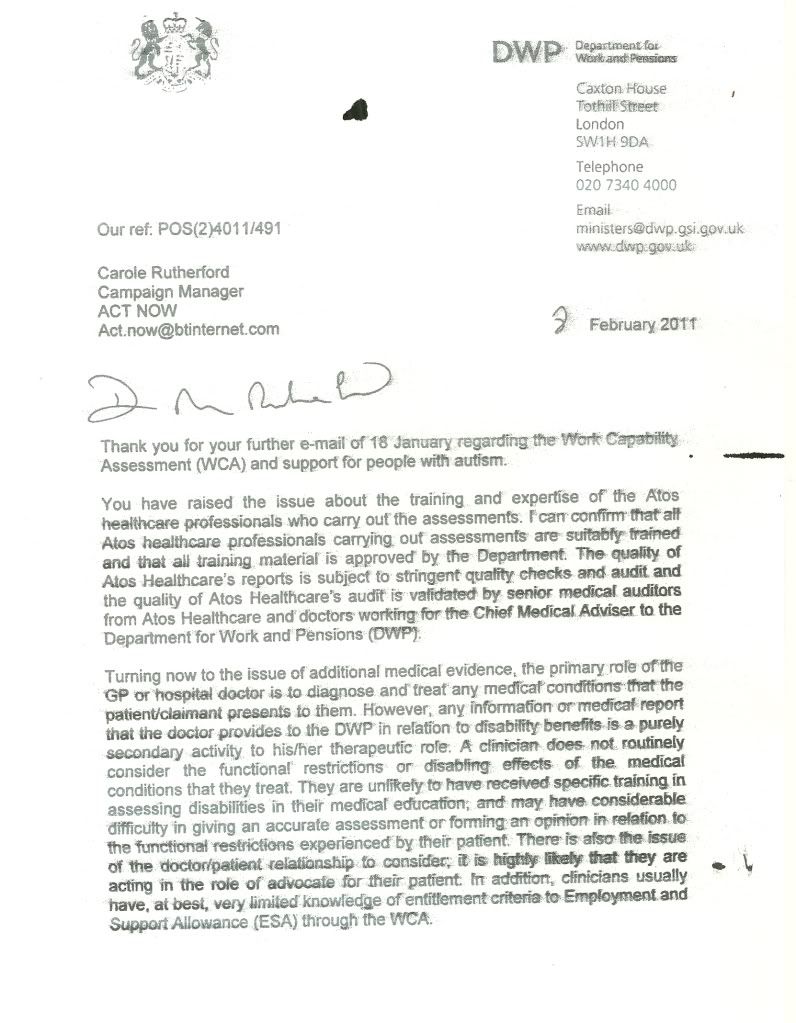
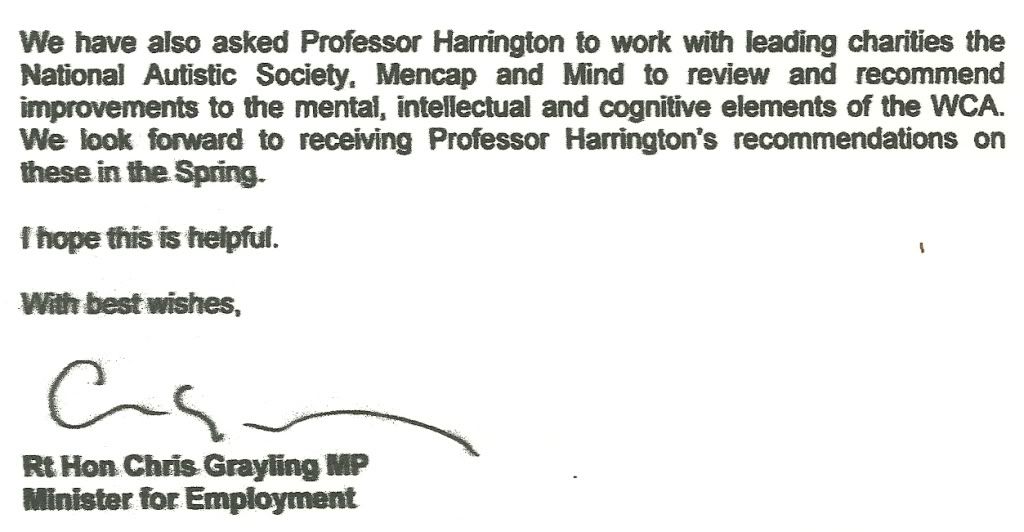
Response from Chris Grayling DWP - Work Capability Assessments


ACT NOW's reply to Mr. Grayling sent today

We thank you for your letter dated 8th February. We have also received a letter from Professor Harrington who tells us that he was copied into your response to our letter dated 18th January.  We are copying Professor Harrington into this letter as well as Iain Duncan Smith and Anne Begg, Chair of the Department of Work and Pensions Select Committee.

ACT NOW seeks reassurance, as do our supporters, that in line with Section 20 part 5 of the Equalities Act an auxiliary aid will be provided for every adult with autism who is asked to take part in a Works Capability Assessment.  

Given that autism affects every aspect of communication, receptive and expressive as well as social communication, we believe that an auxiliary aid (which for an adult with autism would be an advocate/communicator) is a necessary reasonable adjustment. This would help to ensure that adults with autism are not put at a substantial disadvantage in relation to a relevant matter in comparison with persons who are not disabled. 

It is essential to ensure that all of the communication needs of adults with autism are met. We would also state that we believe that it is important that any auxiliary aid that is offered to an adult with autism will be independent and not part of the DWP.
Yours sincerely
-------------------------------

Monday, 7 February 2011

ACT NOW Proposals to our Patron Jon Cruddas MP

Following our meeting at Portcullis House we have given a great deal of thought about not only the Work Capability Assessments and how they could be made autism friendly, but also how a default position for adults with autism, as well as any adult who has a lifelong complex disability, could be made possible.

The core group has, we believe, produced some proposals which would stop the Work Capability Assessment from placing adults with autism at a serious disadvantage. We have also produced some proposals which would be used to create a default setting for adults with autism who wanted to seek and gain employment without any fear of conditionality if their attempts to do so failed.
 
During the last seven days we have discussed our proposals with our Regional Co-ordinators and the 792 ACT NOW supporters who are active members on our Regional Groups. The response has been favourable and we have received no negative comments.
 
We believe that in its present format the WCA will place people with autism and other complex disabilities at a disadvantage. It is not always apparent that someone with autism has a disability because autism can be a hidden disability and the needs of the person with the condition can fluctuate on a daily basis depending on their environment and levels of anxiety.  It can be very difficult for someone who has not been specifically and specially trained in autistic spectrum conditions to effectively determine the impact that the disability has on the person with the condition in a relatively short assessment process.
 
We believe that a radical overhaul of the assessment process is urgently required. Tinkering with the descriptors to decide who should be eligible for Employment Support Allowance and what level of support they should get will not be enough to prevent adults with autism from being declared fit for work, when in fact they are anything but fit for work.
 
While the descriptors may better reflect the needs of people with autism and other disabilities, they will not provide the assessor with the overview and insight into the condition that the assessor should clearly have if they are to reach an informed decision that will impact on the life of the person whom they are assessing.
  
We believe that the Department for Work and Pensions needs to urgently expand its LIMA system (Atos Origin’s Logic Integrated Medical Assessment information technology software) to encompass lifelong conditions like Autism, Down Syndrome, Cerebral Palsy etc and produce a set of guidelines similar to the NICE Guidelines.  It is difficult to imagine how an assessment can be successful without the assessor being able to access information that will allow them to understand the condition that the person they are assessing.
   
Training on Autistic Spectrum Conditions should be mandatory for all ATOS assessors.  
 
At the moment there are only 15% of adults with autism in full time employment. This is opposed to 48% of adults with other disabilities being in full time employment.  While some adults with autism do want to work it must be recognised that for some adults with autism living an independent life without employment will be a positive outcome for that adult. Being able to live independently is something that should be a higher priority than employment for some adults with autism.
  
For this reason we believe that it is essential that there is a default position available to adults with autism (and others with similar disabilities) who try to seek and maintain employment and for whatever reason fail. Autism must be categorized as a high risk group, recognising that adults with this disability often find it difficult to seek and maintain employment.
 
Proposals for long term improvements to the system.
 
There is no reason why all of the assessments that an adult with autism may require (this could include community care and social care assessments) could not be carried out all at the same time under the supervision of a specialist body who is, importantly, not part of the DWP. These assessments could be carried out by a local Community Care Team; a similar idea has been suggested in relation to children with Special Educational Needs and how these are assessed. The outcome of the adult assessment would lead to a Disability Development Plan which would very importantly state the following
 
1. The person's disability and whether this was a statutory disability
 
2. How the disability impacts on them as an adult in relation to key areas such as well being, independence*, employability etc
 
3. What support they are entitled to both in terms of benefits and whilst at work in the form of reasonable adjustments and ongoing support.
 
4. Explore areas of employment that the adult with autism may be capable of doing, as well as what kind of reasonable adjustments and support would have to be put into place for that adult.
 
5. All of the medical needs of the adult would be listed. This is important as adults with autism often have co-morbidities and other disabilities in addition to their autism which impact on their autism and ability to function.
 
The Disability Development Plan could be reviewed for everyone after every 3 years.
 
There should be a mechanism to record significant changes with regards to disabilities and how they affect the relevant person. This may seem like a costly process but firstly it would be voluntary ( ie. if the disabled person did not want to apply). However if the disabled person wanted benefits or community care facilities we suggest it would have to be compulsory. It would be very beneficial to employers as it would give them more meaningful information about the disabled person.
 
Clearly the plan would have to be person centered and a great advantage over the existing system. We have no reason to believe that this way of assessing would not save money in the long run whilst ensuring that the disabled person was given the relevant support when needed.
 
* National Autistic Society Campaign ‘I Exist’ 2008 61% of adults with autism rely on their families for financial support with over 40% of adults with autism still living at home.
 
Do not hesitate to contact us if you have any queries.

Wednesday, 2 February 2011

Letter to Professor Malcolm Harrington, WCA Independent Review, Department for Work and Pensions

Letter copied to Chris Grayling MP and The Autism Programme Board (Department of Health)

Professor Malcolm Harrington CBE
WCA Independent Review
Department for Work and Pensions
Floor 6, Section B
Caxton House
Tothill Street
London, SW1H 9NA

Dear Professor Harrington

We understand that you are at the moment carrying out an annual review of Employment and Support Allowance for the Government to look at how the assessment for ESA can work better for people with autism. We are aware that you have asked the National Autistic Society, Mencap and Mind to develop proposals for the Work Capability Assessment.

ACT NOW (Autism Campaigners Together) launched a campaign in July 2010 after the budget following the announcement that there were going to be cuts to Local Authority, Primary Care Trust and Health Authority budgets and reforms to the welfare system.

We currently have 8,000 parents and adults with autism supporting our campaign. In October last year we published an Impact Assessment Report to make clear the overwhelming concerns that parents, carers and adults with autism have regarding the proposed cuts and benefit assessments.

An important feature of the report was that it drew wholly upon the detailed written submissions of over 4,000 individuals affected by an Autistic Spectrum Condition whose views were sought when drafting our report. For this reason we are proud to say not only that our report is evidenced based but that the evidence has been obtained from those members of our society who can speak with genuine expertise on ASC’s.

Since ACT NOW was formed we have been inundated with concerns from adults with autism and their parents/carers who have either experienced a WCA or who are extremely anxious and stressed by the possibility of having to have a WCA. Having spent some time becoming familiar with the WCA and the Work Related Activity Group we have become increasingly concerned by the 'one size fits all' formula used to carry out these assessments. There is no evidence that any reasonable adjustments are brought into being for people with complex disabilities that may require additional help or support throughout the whole process of assessment.

We believe that in its present format the WCA will place people with autism and other complex disabilities at a disadvantage. It is not always apparent that someone with autism has a disability because autism can be a hidden disability and the needs of the person with the condition can fluctuate on a daily basis depending on their environment and levels of anxiety. It can be very difficult for someone who has not been specifically and specially trained in Autistic Spectrum Condition's to effectively determine the impact that the disability has on the person with the condition in a relatively short assessment process.

We feel that a radical overhaul of the assessment process is urgently required.  At the moment the assessment is not wrapped around a realistic works model. There is an overriding emphasis on what the person ‘can do’ as opposed to what they ‘can not do’ but it is almost impossible to decide what an autistic person can do without first understanding what they can not do.

Amending the descriptors to decide who will be eligible for ESA and what level of support they should get will not be enough to prevent adults with autism from being declared fit for work when in fact they are anything but fit for work.

While the descriptors may better reflect the needs of people with autism and other disabilities, they will not provide the assessor with the overview and insight into the condition that the assessor should clearly have if they are to reach an informed decision that will impact on the life of the person who they are assessing.

We believe that the Department for Work and Pensions needs to urgently expand its LIMA system (Logic Integrated Medical Assessment) to encompass lifelong conditions like Autism, Downs Syndrome and Cerebral Palsy and to produce a set of guidelines similar to the NICE Guidelines.  It is difficult to imagine how an assessment can be successful without the assessor being able to access information that will allow them to understand the condition of the person they are assessing.

We continue to be concerned about the training that ATOS assessors have received about autism and if in fact training on Autistic Spectrum Conditions is mandatory for all ATOS assessors.  

At the moment there are only 15% of adults with autism in full time employment. This is opposed to 48% of adults with other disabilities being in full time employment. While some adults with autism do want to work it must be recognised that for some adults with autism living an independent life without employment will be a positive outcome for that adult.

For this reason we believe that it is essential that there is a default setting available to adults with autism who try to seek and maintain employment and for whatever reason fail. Autism must be categorized as a high risk group, recognising that adults with this disability often find it difficult to seek and maintain employment.

We look forward to your earliest response on these matters.

Yours sincerely

Saturday, 18 December 2010

Letter sent to Eric Pickles MP, Chair of Conservative Party from one of our Supporters

One of our supporters has kindly given her permission to post her letter she has sent to Eric Pickles MP.

Dear Eric,

I remember that when I came to see you with my daughter on another matter, some months ago, you indicated clearly to us both that you well understood the difficult lives that those with Asperger Syndrome and their parents/carers live, and the lack of understanding and support that they receive from most quarters and indeed the obstacles that they (continue to) face.

As you must realize, most people with autistic spectrum conditions, because of their anxiety, fears phobias, OCD, social and sensory and many various other difficulties, live their lives AVOIDING life, in great part, because the stress would be too great to bear. Autism is not a mental illness in itself, but when those with autism are subject to the stresses of life and face a general lack of understanding and support, their mental stability is rapidly undermined. They can also rarely manage completely alone. Families have to watch over them to whatever extent necessary to support their safety and mental survival in a tough oblivious world. Their success in life is a fragile tenuous easily broken thing. They are fragile personalities. Their independence needs continuing support, a watchful eye, and care. Most of the world does not realize that there are other types of mind and perception. Misunderstandings on both sides are many.

This coalition government seems to have absolutely no idea about the situation of those with autism and their families, or they would not have done what they have done, if they had any conscience. They appear to have actively targeted those with autistic spectrum conditions for benefit cuts. I know of 11 people in Essex so far, with Aspergers, who have had certain benefits taken away, and who will have to face the ordeal of an appeal. Imagine being faced with a crucial interview and feeling axious and times that by about 20. Add to this the fact that the outcome witll affect your life and survival.

Also, DLA is being looked at by the Coalition – but it has not invited the National Autistic Society to have any input. As far as I am aware it is still true that the interests of those with autism are not represented at all with this discussion. Why is this? This is truly alarming for those of us who care about the human rights, mental health and indeed survival of those with autism. Apart from the fact that we love our kids with autism fiercely. Autism is a separate strand of disability that needs consideration in its own right.

We all know there have to be cuts, but why take crucial support, from vulnerable individuals, with such indecent haste and with no research AT ALL as to the effects on the victims? Cannot the cuts be spread more generally amongst members of society at all levels?

Please do not forget that most people with ASCs have been forced to attend mainstream schools under the banner of “Inclusion” ( an imposed and misguided – in my opinion - government policy) where because of sensory overload, lack of social skills, problems with understanding language except in the most literal sense, etc etc, they often could not cope, became highly stressed, even suicidal, so received a patchy, incomplete or severely compromised education – as with my own daughter, who spent months out of mainstream school. How are they then to survive in the job market, when so ill-prepared, plus another result is that they can become phobic about being in such situations?

The authors of these severe coalition cuts haven’t referred to recent history, nor to any studies of autism. There seems to be no rationale at all, no reflection or consideration.

They have not provided any alternatives or training.

As you know, even when someone with Aspergers does try very hard to be independent, despite past harships and rejections etc, and get themselves on to an into-work training scheme, (NAS Prospects, which I hear may be running down in any case??) it is still a long-drawn out process to get a referral from the Work Psychologist via the Job Centre etc.

Please could you use your knowledge and experience in the area of autism to influence your colleagues in government, so that they wield their uninformed and cruel axe away from the utterly defenseless, blameless and vulnerable?

Thank you,
Yours sincerely

Monday, 13 December 2010

National Autistic Society response to our questions on the Disability Allowance Reform documents

To the Policy Officer NAS from ACT NOW

We have been reading the Disability Allowance Reform documents and note that it is stated that DWP are developing the new benefit 'in collaboration with a group of independent specialists in health, social care and disability, including disabled people'.  We are assuming/hoping that the NAS are included within the group of specialist/groups that are being consulted with. Do you have any idea at all if there are any adults with autism included within this group?

We are also keen to find out more about their view of the 'objective assessment of individual need' and what that really means. Any idea? 

NAS Response
Thanks for your email. No we are not on the group, and as far as I am aware nor are many of the other disability charities e.g. Scope and RNIB are not on it. I understand that RADAR and Equality 2025 are on it though.

We are asking for a list of members and seeking a meeting with Department for Work and Pensions (DWP). We are very concerned and the key ways we'll be working on this is via lobbying on the upcoming bill and responding to the consultation, we're developing further campaign / lobbying plans at the moment. 

The NAS, as our supporter, are keeping us informed and updated on this matter.  We hope to give you further information as soon as possible.