Thursday, 17 March 2011

ACT NOW will meet with Liam Byrne

The Rt Hon Liam Byrne, Shadow Secretary of State for Work and Pensions
ACT NOW has been invited to attend a meeting with Liam Byrne and the shadow welfare team on Monday March 28th. Other campaign groups have also been invited to attend the meeting.

The meeting has been arranged by Jon Cruddas (ACT NOW’s Patron) and Jonathan Rutherford. The meeting will be carried out under Chatham House rules which we have been told will allow for an open discussion and will ensure trust.

Jonathan has asked us to e-mail 3/4 key points that we would like to discuss on the day. The meeting will last for an hour and a half. It is important that we make as big an impact as possible on the Labour Shadow Team in that short space of time.

For anyone who is not familiar with Chatham House rules here is an outline of what taking part in a discussion while this rule is in place means.

"When a meeting, or part thereof, is held under the Chatham House Rule, participants are free to use the information received, but neither the identity nor the affiliation of the speaker(s), nor that of any other participant, may be revealed".

While this may appear to be restricting it is the way that Ministers and MPs are used to holding meetings. It is possible to report what has taken place at the meeting but not possible to say who said what. ACT NOW's Campaign Manager Carole has personally attended meetings that have taken place under the Chatham House rule on a number of occasions and felt that she was still able to give comprehensive feedback to her own group Autism-in-Mind after the meeting.

We believe it is important to have someone sitting round the meeting table who has a knowledge and understanding of autism who can express their concerns about the Welfare Reform Bill and how it is directly impacting on the lives of adults with autism.

It is vitally important that the Labour Party not only voice their opposition to the Welfare Reform Bill but also rethink their own policy regarding the WCA. It was after all the Labour Party who brought in this assessment.

Tuesday, 15 March 2011

What may happen if Disability Living Allowance is cut - Emma's Story

Today one of our supporters and mum of 3 Emma, all three of her children are on the autistic spectrum, told us of her disatisfaction with the Daily Mirror not covering her story accurately and in full of how losing DLA will affect her family. We quite agree! Her friend and blogger has kindly helped Emma to write her full story which can be found here 
http://www.iamtypecast.com/ along with the Mirror article.

Monday, 14 March 2011

Scotland - How Cuts Affect Real People


Carers Votes Count in this Election
Everywhere you look there are stories in the press about cuts to funding and services – but what does that mean to the people who use those services?

Cuts to local budgets are having a profound impact on the lives of unpaid carers, particularly parents of children with disabilities.  This is largely hidden from the electorate.  And many of the people affected are too tired – or too scared – to hold their heads up and fight for the support they need. 

Support enables families to stay together. Support prevents crises from developing and the need for statutory services to get involved in depth.  Bring into the mix the impact of welfare reform and the drive to reduce numbers claiming disability benefits – there is a tipping point for families and children affected and we are getting closer to it.

Carers’ charities and online campaigners are working together to ensure the voices of these unpaid carers and their families are being heard and responded to during the election campaign.

The Princess Royal Trust for Carers (The Trust) and ACT NOW (Autism Campaigners Together) want to raise the profile of families affected by autistic spectrum disorders. There are an estimated 50,000 people with autism in Scotland and their care is largely provided by unpaid carers, usually parents and siblings.  

The Princess Royal Trust for Carers work with parent carers across Scotland through the network of local Carers’ Centres. ACT NOW are a core group of people passionate about the future and wellbeing of children and adults with an Autistic Spectrum Disorder in the UK.  

With a live campaign on the internet and Facebook, ACT NOW are fighting the cuts to benefits, services and provision – particularly those being experienced by families affected by Autistic Spectrum Disorders.
 
Carers across Scotland save the Government millions – an estimated 1 in 8 people are caring for someone in Scotland. The Princess Royal Trust for Carers, ACT NOW and other campaigning groups want to highlight the horrific circumstances faced by parent carers across Scotland.  

Not recognising and supporting these families could lead to:
  • Parents having to give up work to care for their children or just to enable them to take part in activities and events at school as numbers of personal assistants in school are cut.
  • Children not being supported in class and unable to take part and learn – leading to under achievement, behavioural issues, children being excluded from school and in turn moving into a life of unemployment and poverty.
  • Parents having lifelong caring responsibilities when young people do not achieve independence and the worry about what happens when they are no longer there to look after their adult children.
ACT NOW and The Princess Royal Trust for Carers are calling for the voice of these carers to be heard during the Scottish Election Campaign.  They are calling for existing MSPs and new candidates to lay out what they will do to ensure parents, like those outlined in the case studies below, are recognised and supported better and that children with autism have the same opportunities and life chances as their peers.

ACT NOW in Scotland have been recording the personal testimonies of people with autism and their carers who are being affected by cuts in service provision and by the Work Capability Assessment.  Part of the campaign focuses on challenging the lack of awareness that assessors from ATOS (contracted by DWP) have of autism. ACT NOW is campaigning for the rights of people with autism to have an advocate present from the first point of contact by the DWP.  They are also campaigning for greater input by carers and guardians during the assessment.

More widely, the proposed changes to DLA and the introduction of Personal Independence Payment (PIP) are sources of great concern.  Welfare reform will impact on these families in a hugely negative and life changing way.

ACT NOW are regularly hearing from parent carers who lie awake at night terrified because they don't know what will happen to their adult children, especially if their benefits and support provision is taken away, largely due to ignorance about autism. The health of carers when living with these pressures and strains daily is precarious, especially if they feel they and their children are being discriminated against and don't have a voice. Demand at Carers’ Centres across the country is increasing substantially as local cuts bite and the welfare reform agenda unfolds.  There are lots of warm words about the contribution that parent carers and unpaid carers make – this must be translated into firm commitments and actions.
Case studies

Parent in Edinburgh

Living with a very aggressive son (6). Child and Adolescent Mental Health Services have said they "don't have the resources to support them fully right now". This family is at crisis point and without help from a local charity, they probably couldn't have stayed together.

Parent in South Lanarkshire

Son's (23) Disability Living Allowance Care Component has been reduced from high to low upon review because review deems he doesn't need help to communicate, eat/drink and is not at risk of neglecting himself (amongst other things). None of that is in fact true and no professional who has had contact with this young man has been asked to verify any of his difficulties. This is despite his diagnosis and years of necessary support for these very issues. The parent is appealing but is really struggling financially to support her son as this reduction has meant the removal of her Carer’s Allowance.

Parent in Glasgow

Son (12) hasn't been in school (a specialist unit for children with communication disorders) since early February because there aren’t enough members of staff to ensure his safety. The education department has confirmed that new staff have been found, but can’t confirm when the child will start back in education again because those employees need to be trained. She has had to take legal advice because of poor communication and this has affected her ability to work.

Parent in Aberdeen

A single mum with three kids (one of whom has Additional Support Needs  and is in a special school). Her eldest boy who has Autistic Spectrum Disorder,  has been out of primary school (P6) for months because the school "can't cope" with him because of his challenging behaviour. They have had the police round nearly every day as neighbours complain and she has been advised to lock herself and her two other children away if her son "loses" it. She is at her wits end and has even asked Social Work to take her son into care. They refused as she has the support of her mum.

Friday, 11 March 2011

Friday Fun! time for a guessing game or a game of Simon Says!

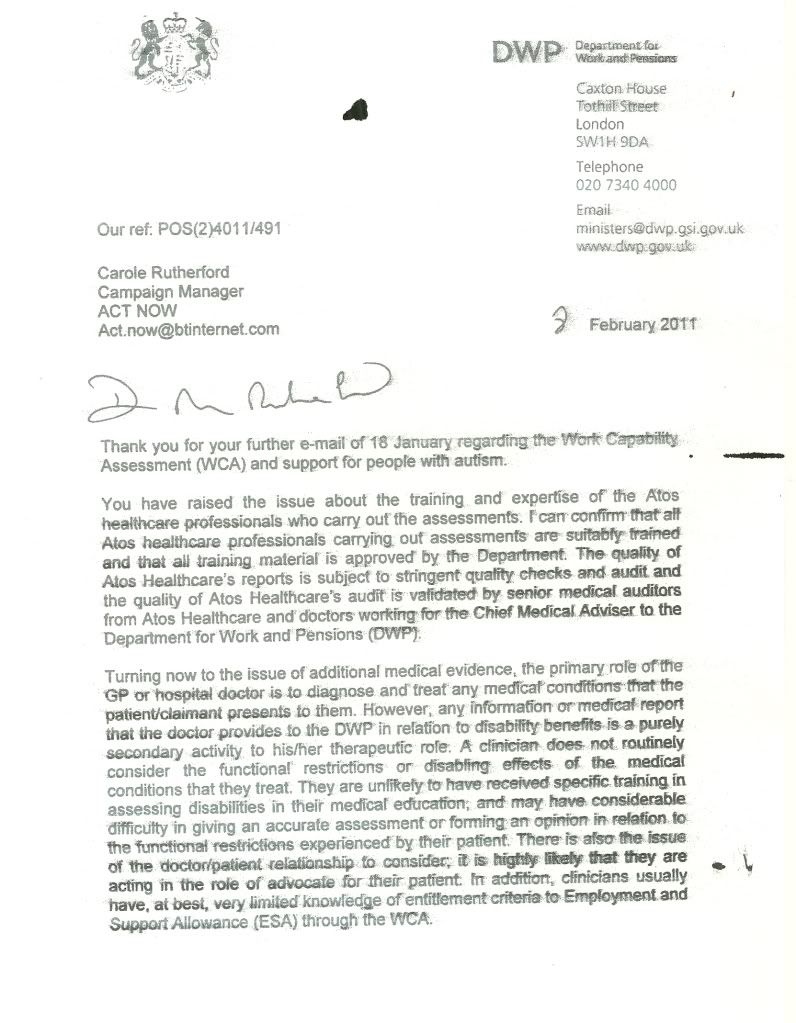
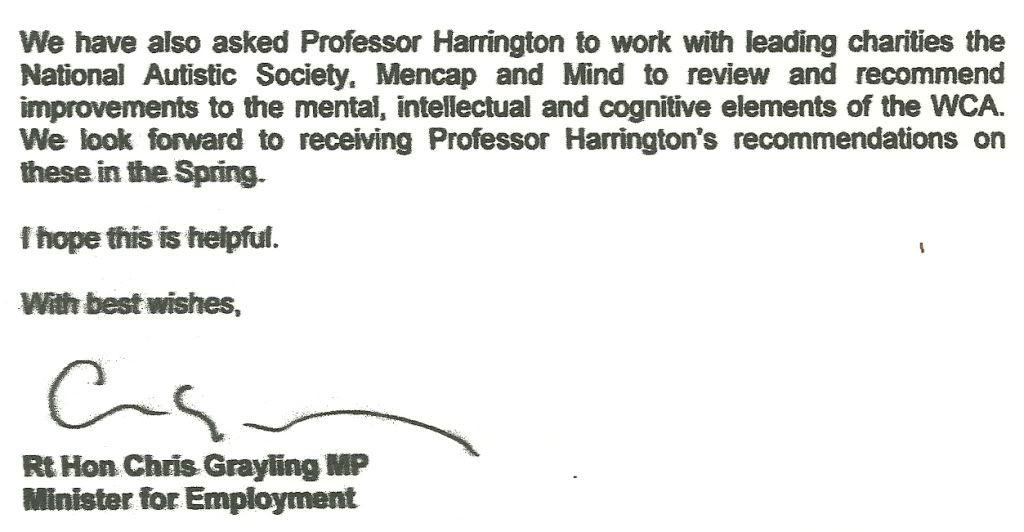
Could the reply ACT NOW received below be a response to our letter to Chris Grayling about our concerns with the DWP factsheet ? how about you decide........let's hear YOUR thoughts!

Wednesday, 2 March 2011

DWP Factsheet: Support offered by Jobcentre Plus for customers with additional support and communication needs

Letter to Chris Grayling, Minister for Employment
Dear Mr Grayling

We are most concerned about the information that is being displayed on the DWP site for customers with additional support and communication needs http://www.dwp.gov.uk/docs/ib-reassessment-additional-support.pdf

The Factsheet states that ‘Customers will receive a letter from Jobcentre Plus telling them that their benefit is being reassessed. Jobcentre Plus will then call the customer to discuss how this change will affect them and to answer any questions.’  Adults with autism will need to be offered support and the opportunity to access an advocate/communicator before the phone call takes place.

The Factsheet continues ‘During this telephone call the customer will be asked if they have any additional communications needs.’ Without support an adult with autism may be unable to identify their own communication needs and being unable to identify and label how their disability impacts on their life is one of the problems that adults with autism face. Therefore it is absolutely essential that adults with autism require an advocate/communicator to be present with them when the phone call is made.

We acknowledge the fact that Jobcentre Plus will support a customer’s right to have representation but an adult with autism needs to be aware of this at the first point of contact. Arrangements then need to be put into place to ensure that support is offered in the form of either an independent trained advocate or someone who the person with autism is comfortable with and who they are happy to help them to communicate effectively.

The factsheet continues by giving specific information for customers for whom English is not their first language, customers who are visually impaired and customers with hearing and speech impairments. The factsheet excludes anyone who has a diagnosis of autism which is a recognised communication impairment.

The factsheet is totally inadequate and should be withdrawn until a proper system can be put in place before any contact is made by Jobcentre Plus.

Tuesday, 1 March 2011

Letter to Archbishop of Canterbury, CofE, The Most Reverend Vincent Nichols, Head of the Roman Catholic Church and The Right Reverend John Cairns Christie, Moderator, Church of Scotland

To the Most Reverend and Right Honourable
Dr Rowan Williams
Archbishop of Canterbury

------------------
To the Most Reverend Vincent Nichols
Roman Catholic Church
------------------
To the Right Reverend John Cairns Christie
The Moderator, Church of Scotland

I am writing to you on behalf of ACT NOW Autism Campaigners Together a group of people passionate about the future and wellbeing of children and adults with an Autistic Spectrum Condition in the UK. The vast majority of the ACT NOW core group live with autism 24/7. We are all volunteers living with autism while trying to ensure that the needs of our children and adults with autism are met.

The ACT NOW Campaign currently has over 8,000 supporters. We have 13 regional groups which includes a group in Scotland, Wales and Northern Ireland. We have 25 Regional Co-ordinators and our support continues to grow on a daily basis. We are also being supported by autism groups and organisations that support families living with autism and adults with autism here in the UK.

The Welfare Reforms and the Works Capability Assessments (WCA) that are currently being rolled out across the UK are placing adults with autism at a huge disadvantage. These assessments are wrapped around the medical model of disability and are in effect discriminating against adults with autism who do not have a medical disability.

ACT NOW believes that it is both cruel and immoral to subject someone with autism to an assessment which does not in any way reflect the vastness of the autistic spectrum. 

ACT NOW does not believe that any reasonable adjustments are being made for adults with autism in line with section 20 of the Equalities Act part 5.
 
Section 20 of the Equalities ACT - The third requirement is a requirement, where a disabled person would, but for the provision of an auxiliary aid, be put at a substantial disadvantage in relation to a relevant matter in comparison with persons who are not disabled, to take such steps as it is reasonable to have to take to provide the auxiliary aid.

Adults with autism are not being provided with an auxiliary aid to help them to communicate effectively.

There are now several MPs and members of the House of Lords and leading autism professionals who are supporting our National Call for Advocate/Communicators for every adult with autism who has to have a benefit review. An Advocate/Communicator would be an auxiliary aid and would fulfil Section 20, part 5 of the Equalities Act.

The WCA have been built around a model of assessment that was first introduced in the United States of America by a group called Unum, who were at one time a leading US disability insurance company.
Autism is a complex condition which is made up of three separate but very significant impairments. Anyone who has a diagnosis of autism will suffer significant impairments with communication, socialisation and imagination (which often presents as fixed and rigid thought patterns and behaviour). This makes autism difficult to ‘fit into’ any of the boxes which are usually occupied by other disabilities.

We do not seek to minimise the impact that other disabilities have but simply to raise awareness of the current plight of those who reside on the autistic spectrum and other adults who also suffer from complex conditions.
While we understand that reform might be necessary, we believe that in its present format the WCA places people with autism and other complex disabilities at a substantial disadvantage. It is not always apparent that someone with autism has a disability because autism can be a hidden disability and the needs of the person with the condition can fluctuate on a daily basis depending on their environment and levels of anxiety.

ACT NOW believes that the WCA process is fundamentally flawed and unless the present method of assessment is completely overhauled, adults with autism and adults with other complex disabilities will continue to suffer and be punished for having a disability which does not fit into the current assessment framework.

The very core of our campaign relates to how people with Autistic Spectrum Conditions will perform in assessments. Adults with Autistic Spectrum Conditions infrequently represent how their disability impacts on them accurately.

People with autism lack theory of mind which means that those with the condition lack the ability to understand how other people feel, believe, what their intentions might be, or what it might be like to be someone else. In other words they lack the ability to place themselves in someone else’s shoes. This means that the person with the condition cannot always relate to themselves having a disability and this is part of their disability. If asked what type of work they could do it is likely that an adult with autism will find it impossible to visualise themselves doing anything which they have not directly experienced. This will result in raised levels of stress and anxiety for that adult.

ACT NOW is already receiving cries for help from adults with autism who are living in fear about these assessments.

The problem is made worse by the fact that real understanding of the condition by the relevant persons is low. In some ways it is a nightmare scenario involving people who 'cannot say' talking to people 'who don’t understand'. With this mix what are the chances of getting the right result?  It is not correct that claims of understanding of ASC are high. If this was the case then 85% of people with Asperger syndrome would not be unemployed.

Works Capability Assessments are a huge concern to us because we believe that adults with autism are being denied a basic human right and that is the help and support that they require to communicate effectively.
If an adult with autism were caught up within the criminal justice system they would be given an advocate and yet adults are not guilty of any crime only that they have a unique disability which does not fit into the WCA framework.

We wrote to Chris Grayling asking him to clarify what is included in the autism training modules that have been developed by Atos Healthcare and the DWP.  We also asked Mr. Grayling if the DWP and Atos are now skills based organisations and accredited/licensed trainers?

The response that we have received from Mr. Grayling has failed to reassure us that adults with autism who are attending these assessments will be assessed by someone who understands their complex condition.
Mr. Grayling has stated in his response to us that any additional medical evidence that is presented to the Atos assessor by an adult with autism will be treated as purely secondary information. He states that clinicians do not routinely consider the impact that a disability a person has will impact on their ability to function.
Mr. Grayling states and it is unlikely that clinicians will have had any specific training in assessing disabilities in their medical training. He states that Atos assessors are specifically trained in the assessment of disability and that a medical disability analyst will be able to provide an accurate and consistent assessment of functional restrictions.

We find this statement very worrying.  Although clinicians may not have received any specific training in assessing disabilities, they are the people who often see the person with a disability on a regular basis. GPs and Consultants often know a great deal about a person which allows them to see how the disability is impacting on the life of that adult. It is also worrying that Mr. Grayling refers to medical analysts being able to assess the impact of a disability that is not a medical condition.

It is our understanding that the training that the Atos assessors have wrapped around autism is very limited and includes a DVD containing information about the condition. Autism is a vast spectrum and it requires a great deal of specialist training before the condition can be understood and accurately assessed.  It often takes years before it is possible to give a diagnosis of autism, such is the complexity of the condition. ACT NOW seriously doubts that the Atos assessors will have received in depth training that is essential before anyone can accurately assess someone with autism.

Autism is not an illness. Adults with an IQ of over 70 often do not meet the criteria to be seen by anyone who has expertise in autism. It is only now that it has been stated in the Guidance which accompanies the Adult Autism Strategy ‘Fulfilling and Rewarding Lives’ (December 2010) that IQ must not be used as a reason to deny an adult with autism an assessment for services or provision. Thus there are huge numbers of adults who have been denied access to assessments for services and provision, many of whom are hidden within our communities unsupported.

We believe that it is unlawful on human rights grounds to force disabled individuals with Autism and Aspergers Syndrome to engage in a process where they are substantially disadvantaged.  Furthermore the DWP need to be mindful of the fact that failure to provide appropriate support will further undermine self confidence and life chances of a group of people who are, without question, one of the most disadvantaged in our society.

ACT NOW believes that the welfare reform is breaking the covenant of care between people with disabilities and the welfare state, and that as a society the support that we have given to those with disabilities is being breeched.  We also believe that adults with autism are being treated less favourably because of their disability and this is a direct breech of the Equalities Act.

We would like to ask you to speak with the Coalition Government and ask them to give you an assurance that adults with autism will not be subjected to an assessment process which has not taken any of their complex and specific needs into consideration.

We look forward to hearing from you at your earliest convenience.

Yours sincerely

Carole Rutherford
Co-Founder & Campaign Manager

Monday, 28 February 2011

Response from Chris Grayling DWP - Work Capability Assessments


ACT NOW's reply to Mr. Grayling sent today

We thank you for your letter dated 8th February. We have also received a letter from Professor Harrington who tells us that he was copied into your response to our letter dated 18th January.  We are copying Professor Harrington into this letter as well as Iain Duncan Smith and Anne Begg, Chair of the Department of Work and Pensions Select Committee.

ACT NOW seeks reassurance, as do our supporters, that in line with Section 20 part 5 of the Equalities Act an auxiliary aid will be provided for every adult with autism who is asked to take part in a Works Capability Assessment.  

Given that autism affects every aspect of communication, receptive and expressive as well as social communication, we believe that an auxiliary aid (which for an adult with autism would be an advocate/communicator) is a necessary reasonable adjustment. This would help to ensure that adults with autism are not put at a substantial disadvantage in relation to a relevant matter in comparison with persons who are not disabled. 

It is essential to ensure that all of the communication needs of adults with autism are met. We would also state that we believe that it is important that any auxiliary aid that is offered to an adult with autism will be independent and not part of the DWP.
Yours sincerely
-------------------------------

Wednesday, 23 February 2011

Letter to the DWP Select Committee

DWP Select Committee Members are: Dame Anne Begg (Chair) Labour, Harriett Baldwin Conservative, Andrew Bingham Conservative, Karen Bradley Conservative, Alex Cunningham Labour, Kate Green Labour, Oliver Heald Conservative, Glenda Jackson Labour, Brandon Lewis Conservative, Stephen Lloyd, Liberal Democrat, Teresa Pearce Labour
-----------------------------------------------------------
Dear Members of the DWP Select Committee

I am writing to you on behalf of ACT NOW (Autism Campaigners Together) a group of people passionate about the future and wellbeing of children and adults with an Autistic Spectrum Condition in the UK.  ACT NOW is run solely by volunteers the vast majority of whom are living with autism 24/7.

The ACT NOW Campaign currently has over 8000 supporters. We have 13 Regional Groups including a group in Scotland, Wales and Northern Ireland, 25 Regional Coordinators and our support continues to grow on a daily basis.  ACT NOW is also supported by autism professionals, groups and organisations that support families living with autism and adults with autism here in the UK. 

The Welfare Reforms and the Works Capability Assessments that are to be rolled out across the UK on February 28th are a source of huge concern for ACT NOW and our supporters. We believe that these assessments will place adults with autism at a huge disadvantage.  

ACT NOW believes that the WCA process is fundamentally flawed and unless the present method of assessment is completely overhauled, adults with autism and adults with other complex disabilities will continue to suffer and be punished for having a disability which does not fit into the current assessment framework.
These sentiments were echoed in an article published in the Guardian Newspaper Tuesday 22nd February where Professor Paul Gregg (economist and welfare reform expert) stated that a ‘rushed roll out of the work capability assessment will cause more anguish’ and that ‘the test is badly malfunctioning. The current assessment is a complete mess’.
We believe that unless the offer of an independent advocate/communicator is made to every adult with autism at the first point of contact, that the DWP are probably breeching the Equalities Act by failing to make reasonable adjustments for someone whose disability impairs both their receptive and expressive language, thus affecting every communication that they make.  

The very core of our campaign relates to how people with Autistic Spectrum Conditions will perform in assessments. Adults with Autistic Spectrum Conditions infrequently represent how their disability impacts on them accurately. These assessments are wrapped around the medical and social model of disability and are in effect discriminating against adults with autism who do not have a medical disability and who continue to fall between the cracks of the medical and social model of disability. 

After writing to Chris Grayling regarding our concerns we received a reply informing us that Atos assessors are specifically trained in the assessment of disability. He states that ‘the medical disability analyst will be able to provide an accurate and consistent assessment of functional restrictions.’ 

Autism is not a medical disability. It is a complex condition whose roots are firmly planted in social and communication impairments.  Autism is diagnosed using a triad of impairments which are communication, socialisation and imagination. It can take months, sometimes even years to obtain a diagnosis of autism. It is difficult to understand how after one assessment it will be possible for anyone who does not understand the complexities of autism to accurately assess the difficulties that that person may have in their everyday lives. 

Mr. Grayling also stated in his letter to ACT NOW that any additional medical evidence that is presented to the Atos assessor by an adult with autism will be treated as purely secondary information. He states that clinicians do not routinely consider the impact that a disability a person has will impact on their ability to function. This greatly worries ACT NOW and our supporters. 

It is our understanding that the Atos assessment is based on an assessment that originated in America and which was used by the Unum Unumprovident, Provident Life, and Paul Revere companies. We also understand that Unum Unumprovident, Provident Life, and Paul Revere companies have been named in almost 5,000 civil actions concerning insurance from 2000 to the present.

We are aware that problems that came to light with the assessment process were disabilities wrapped around mental or nervous disorders which could not be proven by hard medical evidence such as an x-ray. Autism is not a medical condition.

ACT NOW believes that it is both cruel and immoral to subject someone with autism to an assessment which does not in any way reflect the vastness of the autistic spectrum.

It is unquestionably the case that adults with autism often find it difficult to fill in the forms that are usually required to be completed prior to assessments. This is because it is not only their verbal communications that are impaired, but also all other forms of communication including written communication.

Given that it is highly likely that adults with autism will be placed at a substantial disadvantage by these assessments, it is vital that everything is done to support a person during the process. It is essential that the relevant public bodies are proactive in offering and supplying independent and meaningful support at the earliest opportunity.

ACT NOW has been told by adults with autism and their parents and carers that although they are informed that someone can attend an assessment with them, the person attending with them is not always allowed to speak on behalf of the adult. Some parents are reporting that they are not being allowed into the assessment room with their adult child. We have heard via one of our supporters whose daughter is almost non verbal, that while she was allowed into the room with her daughter during the assessment she was not allowed to speak. We find this very disturbing. Adults with autism require someone who can both interpret and communicate on behalf of the person with autism. Interpreters would be provided for anyone who could not speak English. We believe that adults with autism require the same type of adjustment to ensure that they can communicate effectively.

As Atos are part of a consortium which intends to bid for Work Programme provision contracts ACT NOW believes that there is a fundamental and irreconcilable conflict of interest here – part of which is the possibility of bias entering the DWP Medical Assessment, where Atos know that finding somebody fit for work might bring more business their way, whereas finding them unfit for work would not do so.  We have also heard that Atos have targets to meet for getting people off ESA benefit and onto Job Seekers Allowance.

Autism is not an illness. Adults with an IQ of over 70 often do not meet the criteria to be even seen by anyone who has an expertise in autism. It is only now that it has been stated in the Guidance which accompanies the Adult Autism Strategy ‘Fulfilling and Rewarding Lives’, issued in December 2010, that IQ must not be used as a reason to deny an adult with autism an assessment for services or provision. Thus there are huge numbers of adults who have been denied access to assessments for services and provisions, many of whom are hidden within our communities unsupported.   

There is currently no adult autism strategy in Scotland; provision is not statutory once someone with an IQ of higher than 70 reaches adulthood. Adults with an IQ of lower than 70 still have little support and have to fight for what they need. Who will support these adults and provide any additional evidence if required?  Only 7,500 people with autism are known to local authorities in Scotland although the National Autistic Society concluded that, including parents and carers, there are some 200,000 people affected by autism in Scotland. 

We believe that it is unlawful on human rights grounds to force disabled individuals with Autism and Aspergers Syndrome to engage in a process where they are substantially disadvantaged. We believe that being unable to communicate effectively could impact on the health and wellbeing of an adult with autism and the Equalities and Human Rights Commission agrees with us.

ACT NOW would like to request an opportunity to meet with the DWP Select Committee so that we can discuss with you, in person, the concerns that not only the ACT NOW core group has, but the concerns of many thousands who are living with autism everyday share. 

Carole Rutherford
Campaign Manager
For & On Behalf of ACT NOW (Autism Campaigners Together)

Tuesday, 22 February 2011

Join our Supporters Club!

We need to become a force to be reckoned with and to do that we need to be able to speak with ONE VOICE for as many people as possible.
We need named supporters! 
We are fully aware that not everyone in our families are able, or even want to, access the internet. Please ask your family members if they are willing to support the ACT NOW Campaign.
Named supporters can be parents, carers, grandparents, siblings (over 18’s only) aunts, uncles in fact anyone who is a family or extended family member, who can say that they are supporting ACT NOW because they have a relative with autism.  

Thursday, 17 February 2011

Welfare Reform – Thinking Outside of ‘their’ Box

We live in a society where people are neatly placed into the little boxes that have been created to ensure that we all have a box into which we fit.
The biggest issue that people with autism have always had is that they simply to do not ‘fit into’ any of the boxes which were created.
You would think that it would be a simple matter of making sure that they made a box especially for autism. That way autism would then have a space all to itself without forever having to be the ‘cuckoo’ in the disability nest. No such luck. For years and years children and adults with autism have been made, and continue to be made, to ‘fit into’ boxes which were never created with autism in mind.
The plans for welfare reform were rolled out today with the emphasis that this will be something that everyone can do, and that the vast majority of people who are on ‘sickness benefits’ could find themselves a job with a little bit of support, and quite a lot of money being given to, the people who will soon be rolled out to support them.
In a society where ‘personalisation’ has been the buzz word for quite a few years now there was not a hint of personalisation coming through in what ACT NOW has heard or read today. People with disabilities are all going to be forced into the same box and all measured with the same yard stick – Works Capability Assessments.
But how do you measure the disability of someone who has never yet fit into any one of the boxes that were already in existence?  You can not.
The WCA is not designed to wrap around anyone who has a complex 'does not fit into this box' disability.
Last week ACT NOW had a letter from Chris Grayling who assured us that the Atos assessors who will be carrying out the WCA have all been correctly and appropriately trained. This does not fit with the reports of how these assessments are working out for people with autism that are being received by ACT NOW.
Worryingly Mr Grayling also states that any additional medical evidence that is presented to an Atos assessor by an adult with a disability will be treated as purely secondary information.
Anyone else hear huge clanging alarm bells here?
Mr Grayling states that clinicians do not routinely consider the impact that a disability a person has will impact on their ability to function, saying that it is unlikely that clinicians will have had any specific training in assessing disabilities in their medical training.  Atos assessors are specifically trained in the assessment of disability and that these medical disability analysts will be able to provide an accurate and consistent assessment of functional restrictions.
The clue word here is ‘medical’. Autism is not a ‘medical’ condition. So are these disability analysts specifically trained in assessing disabilities whose roots lie in impairments which are wrapped around communication, socalisation and imagination? This is something that we will be asking Mr Grayling.
The reality is that the national roll out of the WCA will begin from 28th February and adults with autism will be assessed using a yard stick which is not fit to measure their complex disability.
ACT NOW believes that it is cruel and immoral to subject any human being to an assessment which was not specifically designed to include their condition.
In an ideal world everyone who wanted to work would be able to do so. In the real world however it is estimated that only 15% of adults with autism do work. This is not because adults with autism are a workshy group of people this is because employing an adult with autism requires employers to ‘think outside of their box’ and provide the kind of support for an adult with autism that adults with other disabilities might not require.
It is not as simple as widening a door for an adult with autism or ensuring that there are suitably adapted toilet facilities for them to use. The adjustments that adults with autism require are much more personalised than that and that is where part of the problem for adults with autism who want to work lies. The reasonable adjustments that would have to be made for them are not the tick box adjustments that would have to be made for other people with disabilities to enable them to work.
While only 15% of adults with autism are in full time employment 40% of adults with other disabilities are in full time employment. This means that even within disability adults with autism are marginalised.
Surely somewhere in our BIG society there are people who can effectively think outside of ‘their’ box to ensure that people who have complex disabilities, who are amongst some of the most vulnerable adults in our society, are recognised as existing and that they will require a degree of personalisation.
People do after all come in all shapes and sizes and so should assessments. It must also be recognised that some people with disabilities will never be able to seek or successfully maintain employment. That does not make their life any less worth living – does it?