Dear Mr. Grayling
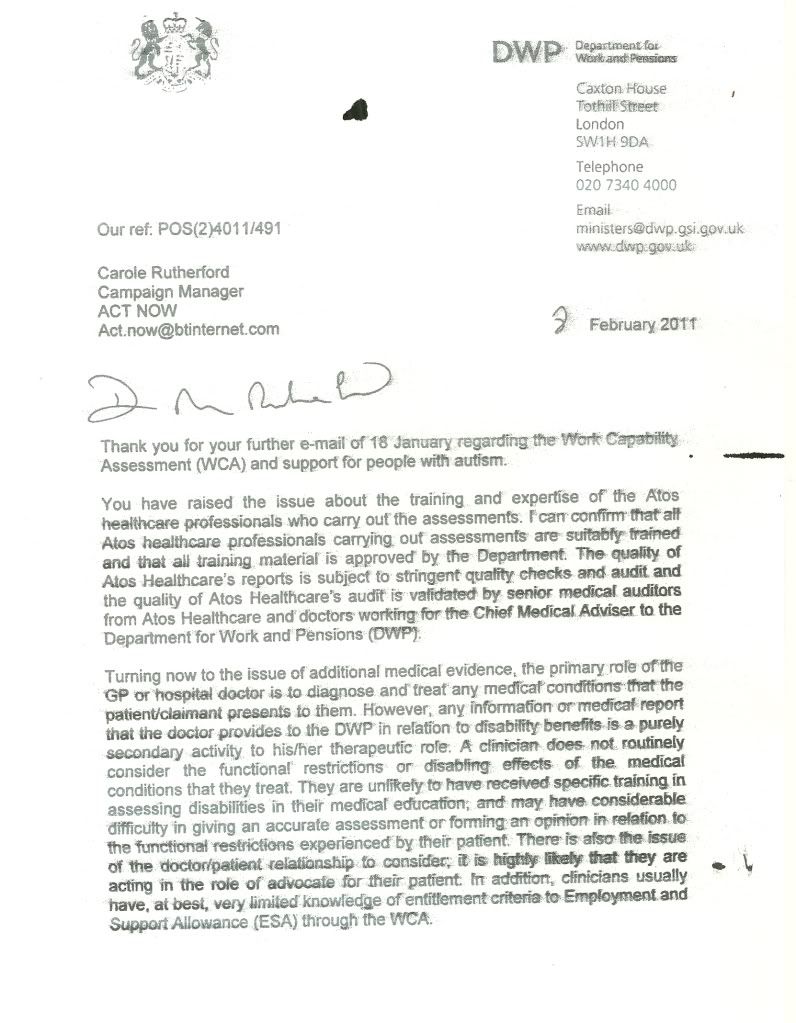
Thank you for your letter dated 20
th January 2011, however we feel that you have failed to answer some of the questions we asked in our letter dated 13th December 2010.
We are pleased to be informed that the ATOS assessors are aware of the potentially disabling effects of impaired social interaction, language and communication skills i
n people with autism and that they are determined to assess customers with autism fairly and accurately. Unfortunately your letter failed to give us an explicit assurance that
all of the ATOS assessors are suitably trained, that the training is accredited and being overseen by an independent body. Can you please assure us that this is indeed the case with all current ATOS assessors and will be true of assessors being appointed?
Every person with a diagnosis of autism has a
significant communication and socialisation impairment; even those with Aspergers Syndrome who often are deemed to be more able than those with a diagnosis of autism. ACT NOW is being told about the inadequacies of the ATOS assessors, that they lack a basic understanding and awareness of the condition of their customers.
We are alarmed that assessors are even overturning professional medical evidence. We do have case studies in support of this.
In your letter you state that the Works Capability Assessment was developed in consultation with disability groups including the National Autistic Society. The NAS states however, as part of an introduction written for Professor Harrington (heading the Independent Review of the Works Capability Assessments for the DWP) that they, along with other organisations, have:
‘experienced some difficulties engaging with the Department for Work and Pensions around welfare reform and at times, have felt that our attempts to influence the process have been limited, with little evidence that our concerns and objections have been considered, and yet our involvement in consultation has been used by government as a source of legitimacy for reforms.’
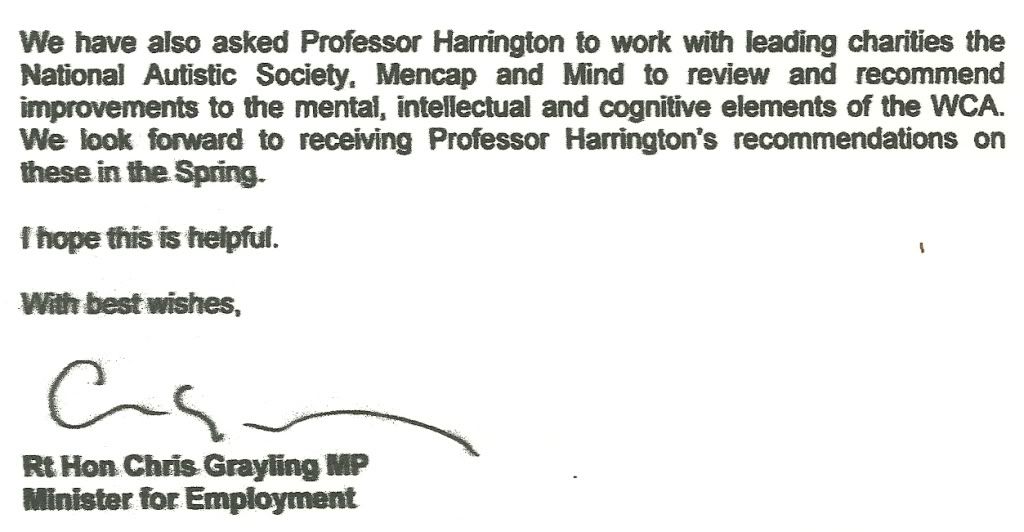
Professor Harrington has asked the National Autistic Society, Mencap and Mind to propose amendments for the WCA descriptors.
We believe that there are a great many factors to be taken into account when a WCA is undertaken on an adult with autism. The capability to work or the inability to be capable to seek or maintain employment, for some adults has been heavily influenced by the failure of the state to provide a suitable education and suitable health care, therapies and interventions for these adults, often throughout their childhood. There is substantial recorded evidence of systemic failure to provide suitable education, therapies and interventions for children with autism (see *1,2,3,4)
Even with Works Choice it is difficult to imagine that some adults with autism are going to be able to not only seek employment but also take up their place in a work environment, whilst lacking the basic skills denied them throughout their childhood, and without which it will be very difficult or in some cases impossible for them to successfully maintain their employment.
ACT Now has heard from adults with autism who want to work and some of whom have worked, that if they are finding it hard to cope with their employment and have asked their employers to contact Prospects (employment consultants offering advice, support and training to managers and their teams) their employers fail to do so, leaving those adults to fail again.
Both children and adults with autism find it extremely difficult to start over after they have experienced a failure in their lives, often requiring enormous amounts of support to be able to do so. The Autism Strategy, which many parents and adults believe will not make the difference that we had so hoped for, has not yet had the chance to bed in and so it is too early to determine if there will be any additional and maintained support for our adults in both seeking and maintaining employment.
Whilst ACT NOW understands that being able to record a WCA would undoubtedly be a step in the right direction, it does
nothing to reduce the levels of stress or anxiety that adults with autism will experience prior to their assessment unless they are able to access,
in their own right, appropriate support. ACT NOW has been speaking to adults with autism and organisations supporting adults with autism and we are being told that
people are worried, some even terrified, at the prospect of WCA assessments.
There is a
huge amount of stress and anxiety being experienced by adults who so far have not even been asked to attend a WCA, such is the fear factor that is surrounding these assessments.
Even the thought of an assessment is affecting their mental health. This of course is not being helped by revelations coming to light that there appears to be clusters of adults in some areas all being declared fit to work when from evidence on the ground, demonstrably they are not.
ACT NOW is making a national call for Advocate/Communicators for all adults with autism. We believe it is essential that all adults with autism are offered support, at the first point of contact, when it is known a WCA is going to take place. It is unquestionably the case that adults with autism often find it difficult to fill in the forms that usually are required to be completed prior to assessments. This is because it is not only their verbal communications that are impaired, but also all other forms of communication including written communication.
Given that it is highly likely that adults with autism will be placed at a substantial disadvantage by these assessments,
it is vital that everything is done to support a person during the process. It is essential that the relevant public bodies are proactive in offering and supplying independent and meaningful support at the earliest opportunity.
There are many adults in our community who no longer have parents to support them and who have not been seen by the medical profession for many years and so they will have no medical evidence that they can submit to the WCA assessor.
Who will these adults be able to access for additional evidence about their condition on their behalf? Autism is not an illness. Adults with an IQ of over 70 often do not meet the criteria to be even seen by anyone who has an expertise in autism. It is only now that it has been stated in the Guidance, issued in December 2010, that IQ must not be used as a reason to deny an adult with autism an assessment for services or provision. Thus there are huge numbers of adults who have been denied access to assessments and many adults are hidden within our communities unsupported.
ACT NOW must point out that it is unlawful to force disabled individuals with Autism and Aspergers Syndrome to engage in a process where they are substantially disadvantaged. Furthermore, public bodies need to be mindful of the fact that failure to provide appropriate support will
further undermine self confidence and life chances of a group of people who are without question one of the most disadvantaged in our society.
ACT NOW has the support of over 8,000 members of the autism community. The overwhelming majority of our supporters either have autism or are the parents of those with autism, in other words people on the front-line all day, every day. We speak on behalf of a considerable number of people and believe it would be most helpful if representatives from ACT NOW were able to meet with you to discuss what
we believe to be justifiable and serious concerns about the Works Capability Assessments and the process leading up to and after these assessments.
Yours sincerely